
Most people think of budget leaks as big purchases — a salon blowout, a new fragrance. The slow drain is subtler: the $4 face mist you grab at checkout, the nail polish that chips in two days, the subscription box you stopped opening three months ago. These aren’t one-time splurges. They’re habits, and habits compound. Tracked individually, each expense looks trivial. Tracked across a month, many people discover they’re spending $80 to $150 more on beauty than they realized — without meaningfully better results.
The Subscription Trap and the Cost of Convenience
Subscription services in the beauty industry have exploded in the past decade, and the pitch is genuinely appealing: curated products, often below retail, delivered monthly. The problem is that the model is designed to outlive your enthusiasm. Behavioral economics research consistently shows that automatic billing dramatically reduces cancellation rates — even when users no longer actively use or want the service.
The math adds up quickly. A typical beauty subscription costs between $12 and $45 per month. If you hold two simultaneously — not unusual for someone with both a skincare and a makeup box — that’s potentially $600 to $1,000 annually on products you may or may not use. The critical distinction isn’t whether the individual products are worth their price. It’s whether the format is serving you or just persisting.
Audit your subscriptions every 90 days rather than waiting until you notice the charge. Ask one question per box: have you actually used or given away every item from the last three deliveries? If the answer is no, the box has become a storage fee, not a value.
- Review all recurring beauty charges every 90 days using your bank’s filter by merchant feature, not memory.
- If a subscription has sent 3 consecutive boxes where fewer than half the products were used, cancel and switch to single purchasing.
- Replace one subscription with a quarterly in-store trip where you select exactly what you need — most drugstores and beauty retailers now offer loyalty rewards that reduce costs by 10 to 20 percent.
Small Products, Invisible Totals
Impulse products under $15 are where monthly budgets most quietly erode. The individual price feels negligible, which is precisely why the category escapes scrutiny. A $6 lip balm at the pharmacy register, a $9 travel-size serum because it was next to the checkout, a $12 “limited edition” shade of something you already own — none of these trigger the internal alert that a $50 purchase would.
The pattern is reinforced by packaging psychology. Travel sizes, minis, and “try me” formats lower the psychological barrier to purchase because they signal a low commitment. In practice, most people don’t finish them. A half-used 1 oz moisturizer costs more per ounce than the full-size version and delivers less value. The beauty industry has built an entire revenue stream on this format specifically because it converts browsers into buyers at a higher margin.
A more useful framing: track these small purchases separately for one month, not combined with your “real” beauty spending. When someone sees $73 in under-$15 purchases listed individually in a spreadsheet, it tends to change their checkout behavior faster than any general budget advice.
Duplication, Expiration, and the Cost of the Unopened
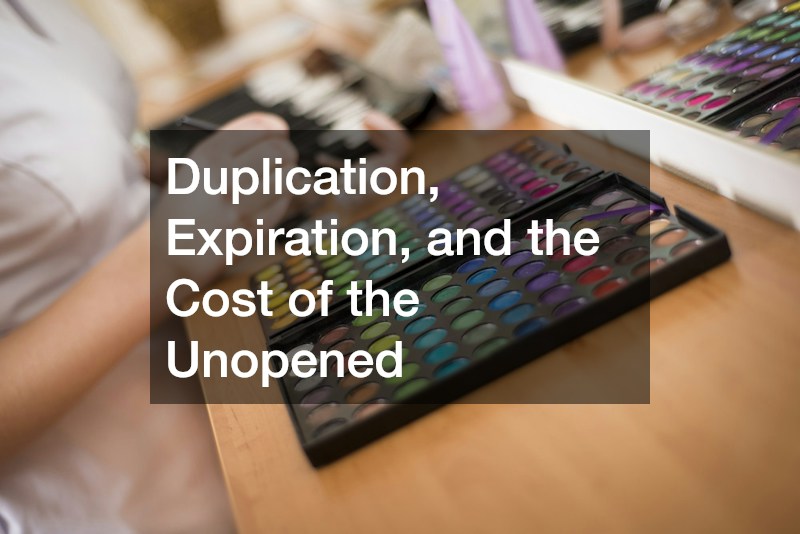
Product duplication is one of the least-discussed budget issues in beauty. It happens when the same function gets filled by multiple products purchased at different times, often because the first product was forgotten or buried. The average person with a full skincare routine owns between two and four moisturizers simultaneously, often without realizing it — one in the bathroom, one in a travel bag, one purchased during a sale, one that came in a gift set.
Products expire. Most opened skincare products carry a Period After Opening symbol — typically 6M, 12M, or 24M — indicating how many months the formula remains effective after unsealing. When a product expires before it’s used, the purchase price is entirely lost. This is especially costly with SPF products, serums, and anything with active ingredients like retinol or vitamin C, which degrade and lose efficacy before they become obviously rancid.
The duplication problem also surfaces in accessories: razors replaced before they’re actually dull, makeup brushes bought twice because the first set was never cleaned and reused properly. Cleaning a set of synthetic foundation brushes with a gentle shampoo twice a month extends their useful life by 6 to 12 months, which is $20 to $40 saved on replacements.
Accessories extend into jewelry, where the same logic applies — owning pieces you rarely reach for because higher-quality staples weren’t prioritized. Shoppers who build around best priced jewelry rather than accumulating cheap duplicates usually find they spend less overall and use what they own more consistently.
- Do a full product inventory every 6 months and discard anything past its Period After Opening date.
- Before purchasing any new moisturizer or cleanser, physically check whether you already own one that performs the same function.
- Clean synthetic makeup brushes every 2 weeks with a diluted gentle shampoo — this alone reduces replacement purchases by roughly 50 percent annually.
The False Economy of Buying Cheap and Buying Twice
Price-driven decisions in beauty often produce the highest long-term costs. This isn’t an argument for premium products across the board — many drugstore formulas perform comparably to their luxury counterparts for basic functions like cleansing, moisturizing, and SPF. The problem is when the decision to buy cheap is driven purely by upfront cost without considering durability, efficacy, or how frequently a product will need replacing.
Nail polish is a clear example. A $4 polish that chips after two days may cost more annually than a $12 gel-adjacent formula that lasts eight to ten days with a proper base and top coat. The calculation changes when you factor in the number of applications, the time cost of repainting, and the cotton and remover used in each removal.
The same logic applies to tools: a $10 eyebrow razor that requires weekly replacement versus a $28 trimmer with replaceable blades that lasts two years. On a per-use basis, the cheaper option often costs significantly more.
Where to prioritize quality over price: tools and devices used daily (tweezers, nail files, facial cleansing brushes), SPF products used in volume, and any product applied near eyes or with active ingredients. Where drugstore is genuinely sufficient: micellar water, cotton rounds, basic lip balm, and hair ties.
Recalibrating Before Your Next Restocking Run
Before the next shopping trip, pull three months of bank statements and isolate every beauty purchase, however small. Most people are surprised by the total — not because of any single decision, but because of how many low-awareness purchases accumulated. The goal isn’t to cut spending aggressively; it’s to make the spending deliberate. Decide in advance what you actually need to restock, what can wait, and what has been replaced by something already in the cabinet. That single habit — deciding before browsing rather than during — tends to reduce beauty spending by 20 to 30 percent without requiring any sacrifice in the results.